


Eritrea's Democratic Revolution Is Brewing
- Details
From the U.S. to Sweden, from Germany to Ethiopia – and in Israel too: Hundreds of thousands of Eritrean refugees have joined forces to return to the homeland they fled and free it from dictatorship. The revolution, they promise, is coming soon
n a warehouse in south Tel Aviv, people sit and plan a revolution. They have dreamed of it for 20 years, even longer, but they have had their fill of dreaming. Now, they say, these are days of fulfillment. Soon everything will happen, any moment the dam will burst, a little longer and they will be there, in the home they fled. More than any argument they make today, it is the look on their faces that testifies to their intentions. No one is toying with the idea, and no one feels any need to soften the rhetoric. Yes, they insist, we are the people who will lead Eritrea's democratic revolution.
The warehouse, tucked among buildings under renovation, is one of their organizing hubs around the world. From the U.S. to Sweden, from Germany to Ethiopia. Sitting here now are Atakliti Abraham Michael and Mulue Sultan, leaders of the Eritrean community in Israel and two of its representatives in the revolutionary movement.Dawit Teferi, a Canadian-Eritrean businessman and the movement's finance manager, joins by Zoom from Washington. In Addis Ababa, the movement's leader, Beyene Gerezgiher, is waiting. Some 2 million Eritrean refugees and asylum seekers live in these countries, and the group intends to lead them all back to the homeland.
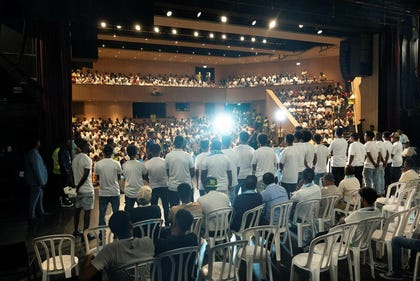
"Our opposition was ineffective over the last 20 years," says Teferi, 43, the son of an Eritrean father and an Ethiopian mother who were granted asylum in Canada. "Since 2022, a real opposition has emerged. New faces, new voices and also new methods." The leadership so far includes people responsible for finances, diplomacy, community building and military organization. They call themselves Brigade Nhamedu.Eritrea won its independence from Ethiopia in the early 1990s, but it has known no freedom since. Isaias Afwerki, one of the leaders of the liberation struggle, became its president in 1993 and has not left power since. National elections have not been held, the constitution has never been implemented and the independent press has been shut down. Eritrea has steadily become a dictatorship. Young people there are conscripted from the age of 14 into military service with no discharge date, and multitudes are held behind bars without cause. The 3.7 million residents who remain are forced to ensure the continued rule of Afwerki, now 82, as the country declines in every area.Last month, on a Saturday in a hall in Nes Tziona in central Israel, some 1,300 members of this community took part in an election. They filled the rows of chairs and the upper gallery. Women in long blue dresses sat in front, some wrapped in thin white scarves. On the stage, a table and plastic chairs had been set out for the community leaders, the candidates for the brigade's international council of representatives. There was no tension and no rivalry, but rather a festive atmosphere. At the end of the event, on the stage and in the galleries, community members clasped hands, raised them together and sang out loud.Seventeen similar events were held around the world during those days. At these events, with seats allotted according to each community's size, each one chose its representatives. In all, the council numbers 51 members and since then, according to council member Mulue Sultan, it has convened every week for three-hour sessions. They discuss funding, the division of responsibilities, the establishment of a base in Ethiopia and contact with those who remained in Eritrea, creating the conditions needed for the day of the revolution.
One community across the whole world
Beyene Gerezgiher is the man meant to lead them there. Even through Zoom, his strength is easy to make out, the indefinable energy people look for in a leader. His bearing, too, has something presidential about it. He has a short, rounded Afro above a high forehead, and a neat beard follows the line of his jaw. Gerezgiher is in no hurry to claim his place in the conversation or to assert his standing. This is not modesty but self-assurance. When his turn comes he speaks calmly and often with a smile, but directly. "Behind us are masses of people ready to fight for their country," he says.
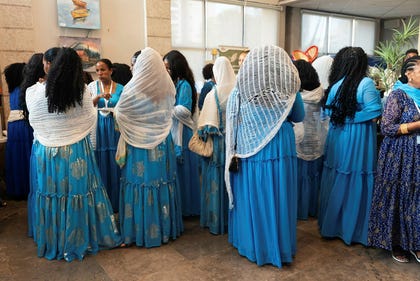
The election gathering in Nes Tziona last month. Some 1,300 members of the community took part. Credit: David Bachar
He left Eritrea in 2012, and shortly afterward fell victim to human trafficking in Libya. Only a year later did he manage to reach the Netherlands, where he settled. "My personal trauma drove me to become a human rights activist, for all people," he says. Three years later he began to build up support. Every week he posted monologues to the Eritrean people on social media, traveled to meet communities around the world and became a familiar face in the diaspora communities. "That's how, over time, we created a single political community that exists all over the world," he says.
It cannot be taken for granted that people would respond. Under a regime that punishes dissent, the people learn to be wary even of one another. A UN report from May 2025 describes how surveillance and threats follow Eritreans into exile as well, and how relatives who remained in the country are exposed to punishment. Gerezgiher says the regime also tried to infiltrate the movement and break it apart from within. "We learn from the failures of previous generations," he explains. "The current generation is managing to act together, as one force and with one goal – to replace the regime."
In his speeches, the organization says, hundreds of thousands watch inside Eritrea itself. The reach inside the homeland, despite limited internet access, is the product of their efforts. Alongside smuggling and other means, Gerezgiher says a team on behalf of the brigade cuts key segments from his speeches and interviews and works them into a musical arrangement, so that the messages sound like a song.
"We have sources inside the country, from ordinary people to senior figures in the army and the government," he says. "We know the masses are waiting for us, especially in Asmara [the capital – R.S.]. People spray-paint our name on the walls – in the streets, in schools, in prisons. We are engaged in spreading these messages as widely as possible."
"A day will come and we will return"
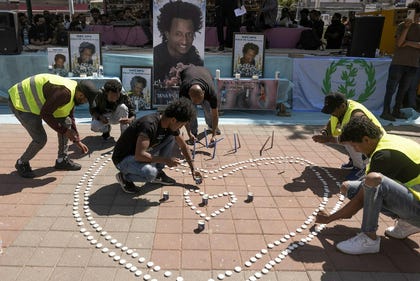
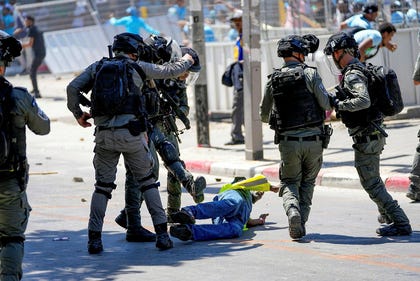
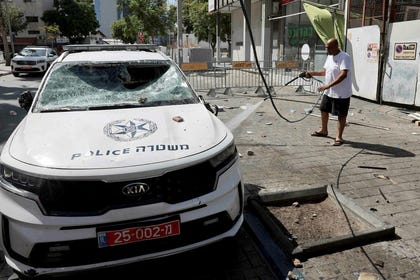
In Israel, this hostility erupted onto the streets in September 2023. A festival that the Eritrean embassy planned to hold in Tel Aviv led to clashes between opponents of the regime, who wore blue, and its supporters, who wore red. Around that time, Eritreans also clashed in Sweden, Germany, Canada and the U.S. The violence in Israel continued even after the event ended and the streets were cleared. According to the UN report from May 2025, at least nine Eritreans have been killed here since September 2023, among them both opponents and supporters of the regime.
Sultan, who has lived in Israel since 2008, believes Israel should long ago have distinguished between those who fled the regime and those who support it. "It's very simple: The police should go to the events that the Eritrean embassy in Israel holds, photograph the people who are there and arrest them," he says. "I'm the first to support deporting regime supporters."
Speaking from Washington, Teferi says no one in the brigade foresaw these violent outbursts, and regrets that they occurred, but acknowledges that afterward they realized that people's emotional bond to their homeland, and their aspirations to break free of the dictatorship, presented an opportunity to build a genuine alternative for Eritrea. "That's where a real opposition apparatus began to form," he says.
For Atakliti Abraham Michael, his opposition to the regime came at a cost to his children. He arrived in Israel in 2011, after military service and an escape through Sudan and Egypt. For almost a month he slept in Levinsky Park in south Tel Aviv. Then he washed dishes, became a cook and worked in a nursing home. Today he cleans stairwells. His three children stayed behind in Eritrea and paid, he says, the price of his activism. His eldest daughter was conscripted into the army, and his son was pulled out of school and imprisoned for two years until he managed to escape to another country in Africa. "My youngest son, 14, is in detention until age 17, and from there they'll conscript him into the army."
He barely knows them. Even before he fled, he would come home from the army on short leaves and then return to service. Only his eldest daughter, who was small when he left, still remembers him. With his two sons, from the day they learned to speak, at most he has spoken to them by phone. His mother, too, has not seen him in years. "None of them knows what I look like today," says Atakliti, a tall, sturdy man who is now on the verge of tears. "First of all, I'm fighting to get back to my children," he explains. "Almost two million of our people are scattered all over the world. We have our national story, but each person also has his own personal story."
Sultan's four children already live in Canada. He is 46, and since arriving in Israel he has worked in construction, in nursing homes and at an egg-production plant, and even run a wedding-dress shop. Today he works as a Wolt courier. Sultan is one of the few fortunate Eritreans who received official recognition as refugees in Israel. And yet, he feels his life will not be complete unless he returns home. "At first we got here and tried to survive. To work, to recover from what we'd been through. But you know," he explains, "no one wants to be a refugee forever, everyone wants to go home."
And what about the younger generation, those born here who know nothing but Israel? Will they come with you?
"They won't refuse. They grew up on the idea that we have a country of our own, that a day will come and we will return."
That's not what I hear from them. Many of them don't feel any special obligation or connection to Eritrea. The biggest dream of quite a few of them is to enlist in the IDF.
"Listen, right now they're suffering here too. They feel they have no future here. They see it. After they finish high school, all the doors are closed to them. They won't go to a ruined, broken country, but if there's a revolution – I think they'll come."
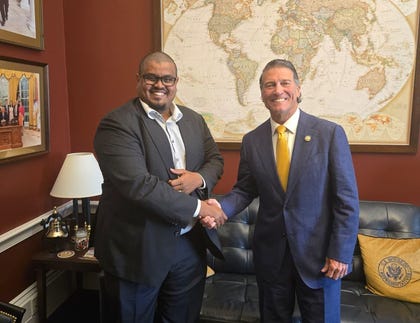
Teferi spends his days in Washington courting members of Congress and officials in the U.S. administration. He makes a point of being photographed with them and publicizing the meetings he holds. The support he hears from them, he says, is more than sympathy. He is willing to explain, but chooses his words carefully. "The U.S., Israel and the Gulf states have a major interest in a partner in the Red Sea region," he says. That interest, he says, can work in their favor, turning exiles seeking help into people worth helping into power. "It takes time," he says, "but many doors are open to us. We're in a very good position."
Gerezgiher offers a slight qualification. The ties in Washington, he says, are not yet official recognition. "We won't be able to carry out a democratic revolution in Eritrea on our own. We need international support." Still, he credits the diplomatic efforts with the fact that he now lives in Addis Ababa. According to a report by the research organization International Crisis Group, Ethiopia has been openly hosting the movement since early 2025. "We have a free hand to operate from here," Gerezgiher says.
That is also where they intend to build the force that will let them cross the border when the day comes. "The dictator won't grant us free entry," he says. "We haven't recruited people, but the masses are waiting for the day they'll be called. We're ready for the right moment, and I think we're close to it. Very close."
 Source: https://www.haaretz.com/


